


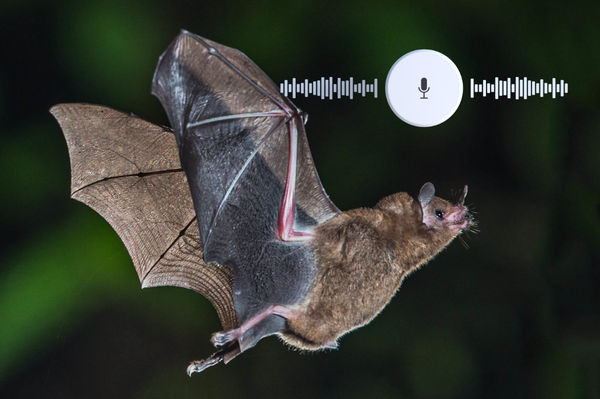
Tropical Bat Call Detection and Classification
Transforming bat population monitoring in Cambodia through advanced bio-acoustic analysis driven by Machine Learning algorithms.
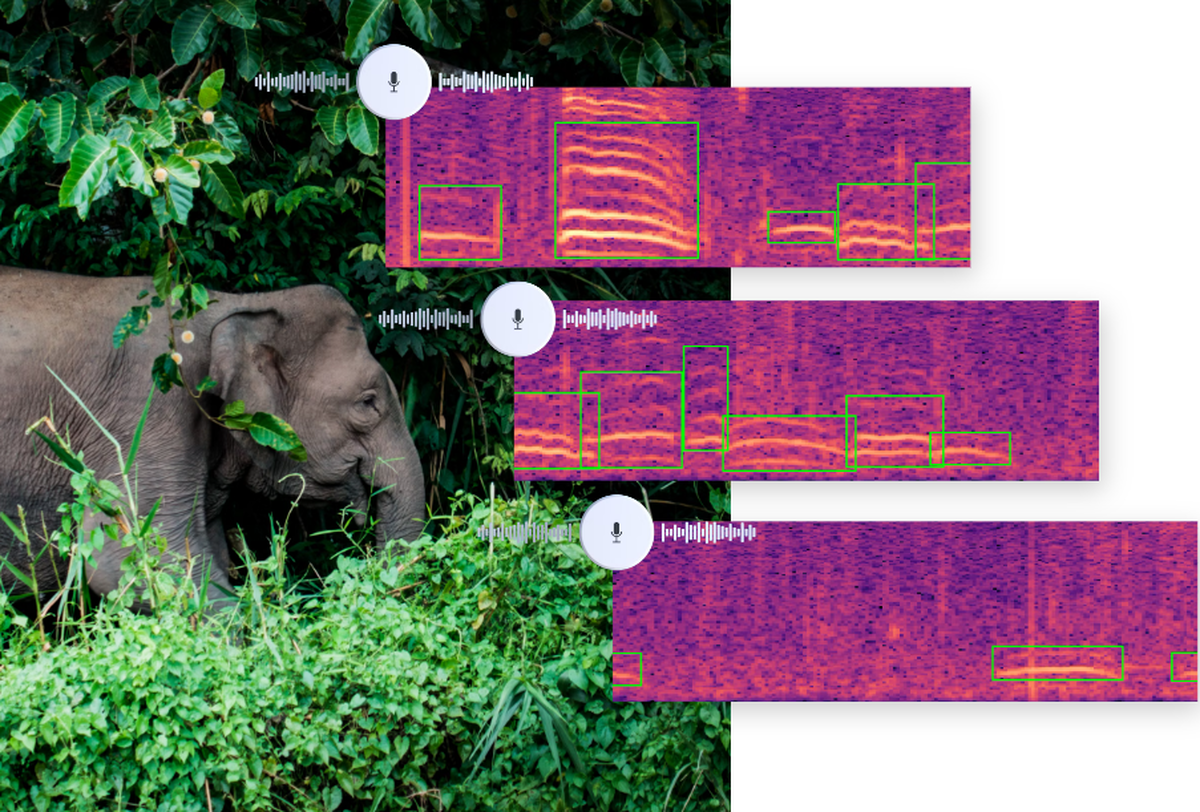


Finding forest elephants, and poachers, by sound across Central Africa's rainforest.
Forest elephants are vanishing: more than 60% have been lost in the past decade, and over 12,000 are killed each year for their ivory. The hardest part of protecting them is simply knowing where they are. In the vast, dense rainforests of Central Africa they are nearly impossible to see, so instead of watching for them, we listen.
Working with the Elephant Listening Project and the Cornell Lab of Ornithology, we built open-source tools that scan terabytes of forest audio to automatically detect and localize elephant rumbles, turning sound into the population and anti-poaching data that conservation has been missing.
Our vision is to conserve the tropical forests of Africa through acoustic monitoring, sound science, and education, focusing on forest elephants.
– The Elephant Listening Project
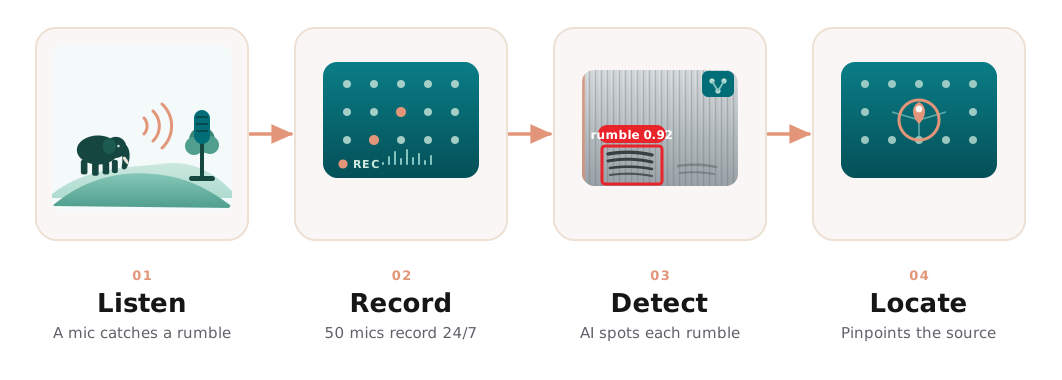 Microphones across the forest record around the clock, a model finds rumbles in
the audio, and the array pinpoints where each call came from.
Microphones across the forest record around the clock, a model finds rumbles in
the audio, and the array pinpoints where each call came from.

Forest elephants are ecosystem engineers: the rainforest is shaped by their daily lives, and unravels without them.
They eat fruit and spread seeds across huge distances, and their movement opens clearings and trails, keeping the forest diverse, regenerating, and in balance.
By promoting forest growth they help these forests store carbon, and by digging for water in dry riverbeds they create water holes that sustain other species through the dry season.
Their nutrient-rich dung fertilises the soil and feeds insects and fungi, while the dynamic habitats they maintain let countless plants and animals thrive.
Forest elephants face pressure from every side, and their slow reproductive rate means losses are hard to recover from. Tap each pressure to learn more.
Forest-elephant ivory is prized for its hardness and rose-coloured tint, driving targeted killing of more than 12,000 elephants a year. It is hard to detect in dense, poorly-protected forest.
Hunting elephants for meat has grown into an international business, threatening animals of all ages, including calves, as human populations grow.
Logging, mining and oil extraction are the most pervasive industry pressure, reshaping the forest elephants depend on.
Roads cut for extraction open once-remote forest interiors to hunters and settlement, multiplying the threat to elephants deep in the range.
Forest elephants breed slowly, so populations recover far more slowly than they are being lost, compounding every other pressure.

We have lost 60% of all forest elephants in the past decade.
– The Elephant Listening Project
Rumbles are the low-frequency calls elephants use to communicate. Much of a rumble sits in the infrasound range, below 20 Hz, often beneath the threshold of human hearing.
Because their wavelength is so long, rumbles travel several kilometres and pass through dense forest, letting elephants stay in contact across vast areas they cannot see across. They use them to coordinate and bond as a herd, to signal readiness to mate, to raise the alarm at danger, and to keep mothers and calves together. That same far-carrying signal is what makes the forest listenable: if we can reliably pick rumbles out of the noise, we can find elephants.
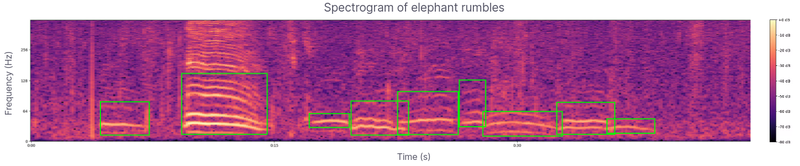
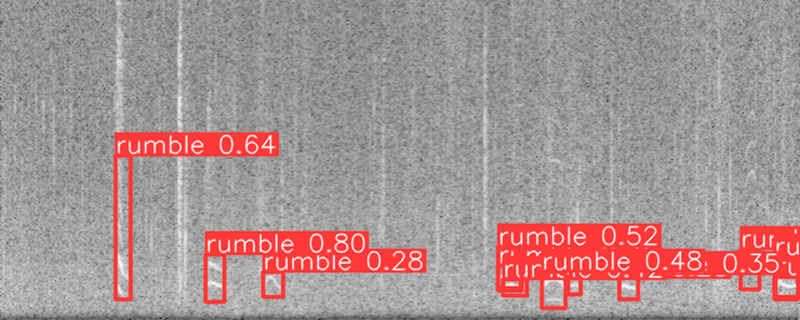
Fifty microphones are arranged in a grid across the tropical forest, recording continuously. The challenge is the sheer volume of audio. The answer is a model that finds rumbles in a spectrogram the way an object detector finds objects in a photo.
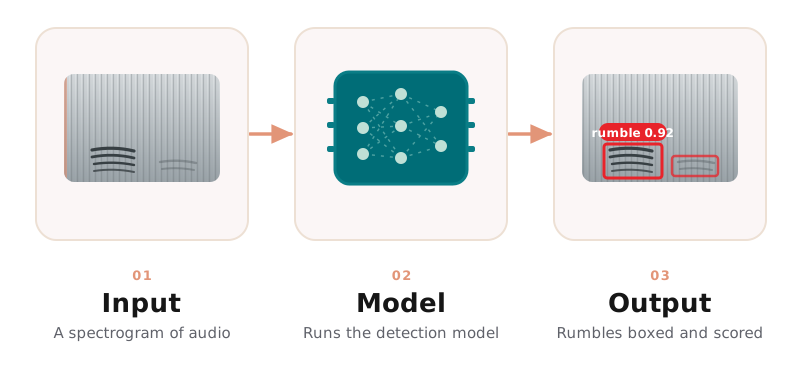 Each chunk of audio becomes a spectrogram; the model boxes every rumble and
scores it.
Each chunk of audio becomes a spectrogram; the model boxes every rumble and
scores it.
The open-source tools process audio in batch across all available CPU and GPU cores, so a 24-hour recording is scanned in around 20 seconds. At that speed, a full month of audio from all 50 recorders (roughly 1 TB) is analysed in about 8 hours rather than weeks of manual review.
| Spectrogram | Detected rumbles |
|---|---|
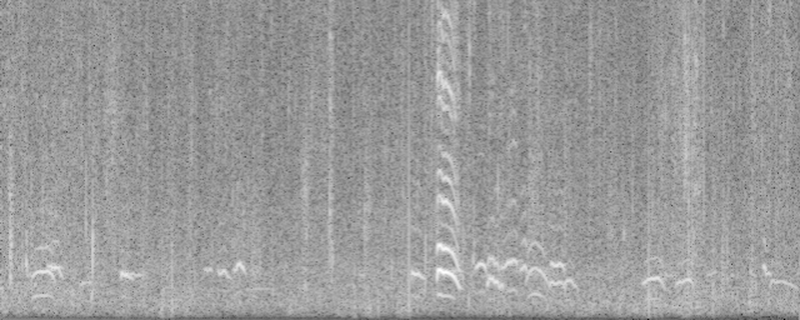
|
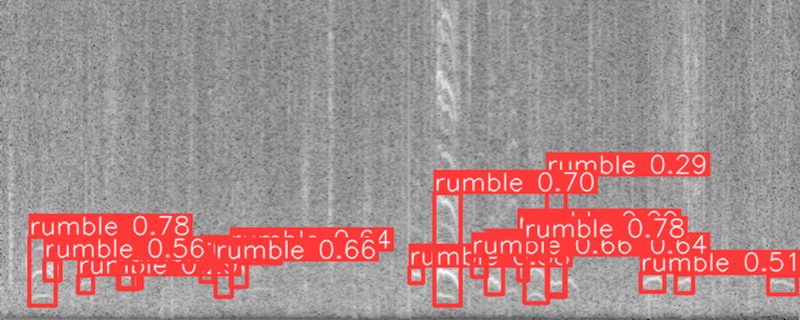
|
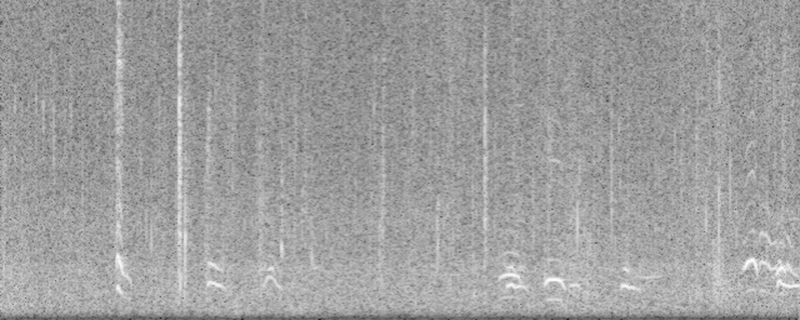
|
|
Analyzing months of audio recordings can now be done in a matter of hours, not weeks.
We cover how the detector was built and run in the companion post on analyzing elephant rumbles at scale.
Listening turns the hardest part of forest-elephant conservation, finding animals that can’t be seen, into continuous, non-invasive data. Around-the-clock acoustic monitoring reveals where elephants are over time, surfaces signs of poaching, and gives rangers and researchers the evidence they need to act, at a scale and cost that field surveys never could.
See the model in action right in your browser. Try it on the built-in examples or your own data. No install, no setup.
Open the demoWe build conservation technology with partners in the field. Tell us what you're monitoring and we'll tell you what's possible.

Transforming bat population monitoring in Cambodia through advanced bio-acoustic analysis driven by Machine Learning algorithms.
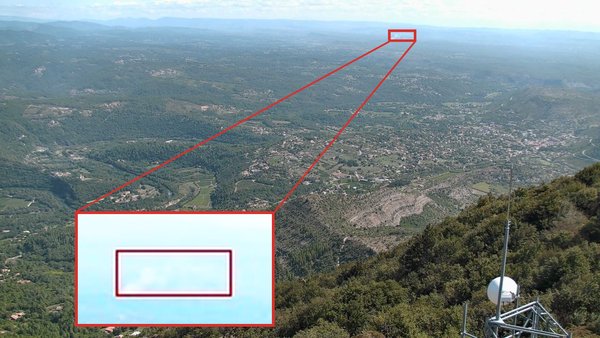
Democratize open and low-tech solutions for fighting wildfires, for the benefit of the ecosystems and the citizens.
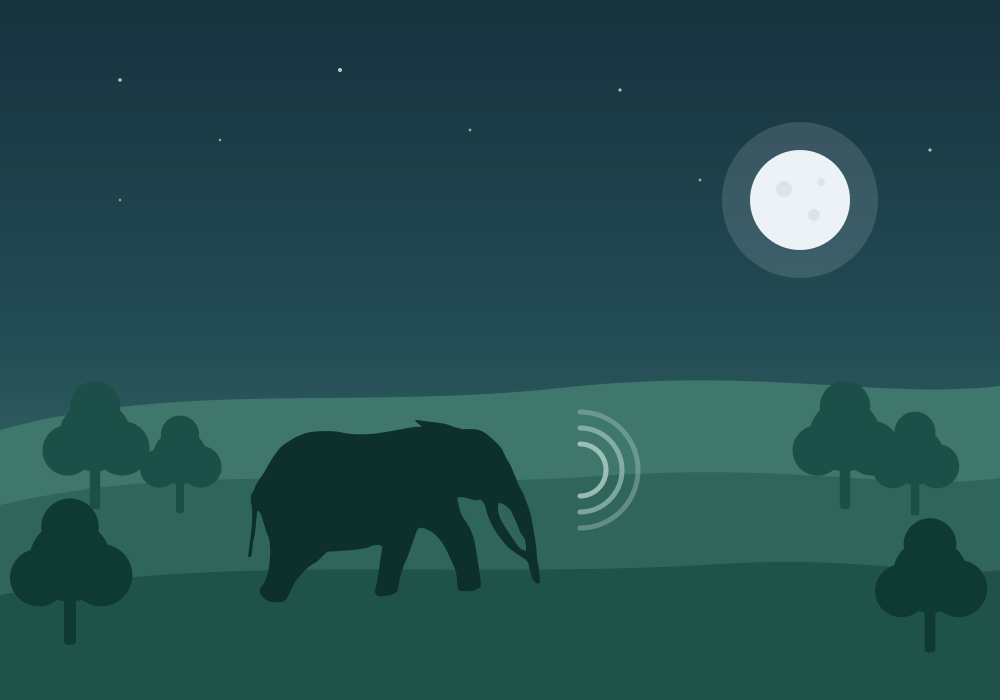
Listening to African forests to detect and classify elephant rumbles from audio recordings.
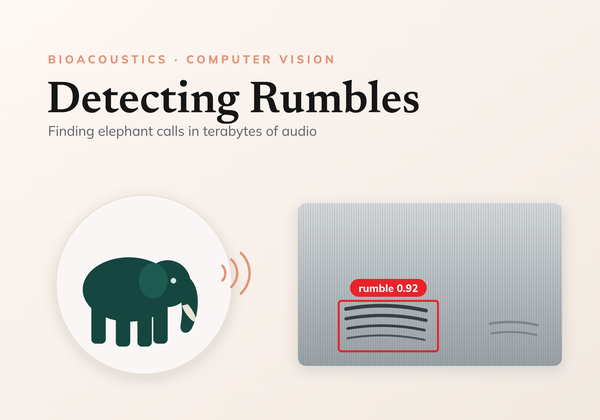
Learn how to leverage audio processing to localize elephant rumbles on terabytes of data.