On this page
EarthRanger is the operations platform behind real-time conservation at more than 900 protected areas: one live map of tracked wildlife, ranger patrols, vehicles and sensors, built and maintained by the team at Ai2. In 2024 we joined its engineering team for a scaling mission on the backend. This post is about the first front of that mission: separating reads from writes, so the database that every map refresh and every collar ping lands on stops being the ceiling on the platform’s growth.
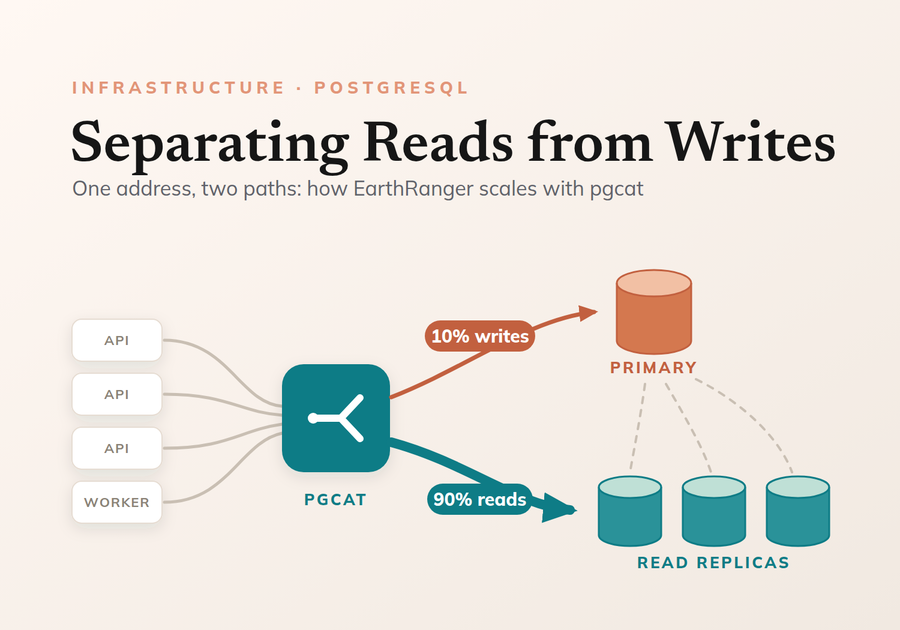
The number that framed the whole project is a simple one. Roughly 90% of EarthRanger’s database load is reads and 10% is writes. Until this work, all of it queued on one PostgreSQL primary.
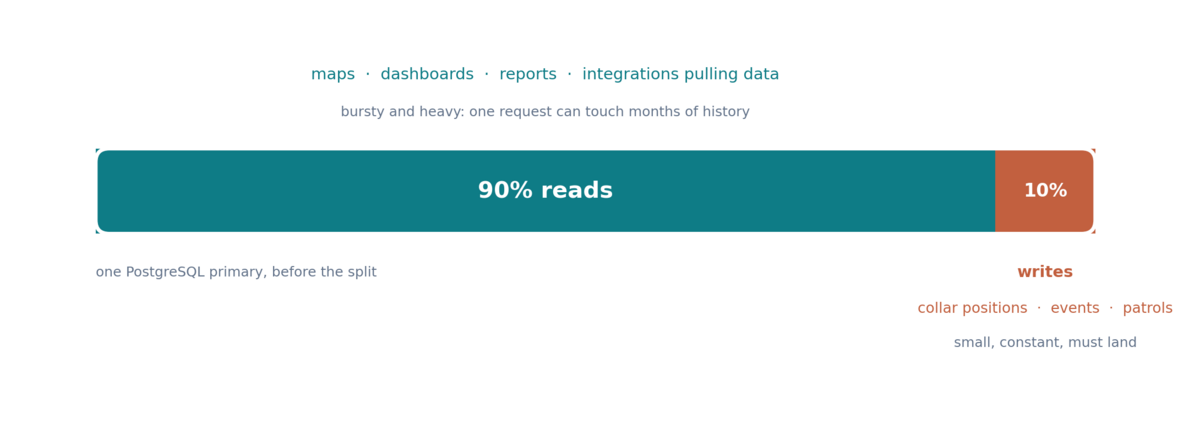 Nine out of ten queries only read. They were competing with the one in ten
that must land, on a single database.
Nine out of ten queries only read. They were competing with the one in ten
that must land, on a single database.
The problem: reads and writes fight over one database
The two workloads could not be more different.
Writes are small, constant and non-negotiable. A GPS collar reports where an elephant is right now. A ranger files an incident from the field. A sensor integration pushes a batch of observations. Each of these is a few rows, but they arrive around the clock, from every time zone at once, and every one of them must be stored.
Reads are bursty and heavy. A manager opens the map and the platform assembles the last positions of every tracked animal in the area. A report pulls months of patrol history. A dashboard aggregates events across a whole landscape. Each of these is one request, and each can touch orders of magnitude more data than a write.
On a single database these two workloads share CPU, memory, disk and locks. A heavy report holds resources that the ingestion path needs; a burst of dashboard refreshes at the start of the working day slows down the collar pings arriving at the same moment. The classic answer is to buy a bigger primary. That works until it does not: a single instance has a ceiling, every step up costs more than the last, and it does nothing to change the fact that 90% of the traffic does not need to be there at all.
PostgreSQL has a much better answer for read-heavy workloads: read replicas. A replica is a copy of the primary that receives every change through streaming replication and can serve any query that only reads. Google Cloud SQL, where EarthRanger’s PostgreSQL runs, can attach several of them to a primary. The hard part is not creating replicas. The hard part is getting a large, live Django application, with hundreds of query sites written over many years, to send the right query to the right database without rewriting it.
The idea: one address, two paths
The application should not have to know. That was the design constraint we set ourselves: the API, the background workers and the integrations keep a single database address, and something between them and PostgreSQL decides where each query goes.
That something is pgcat, a PostgreSQL connection pooler.
A connection pooler solves a problem every PostgreSQL application meets as it grows. Opening a connection to PostgreSQL is expensive: the server starts a dedicated process for each one, with its own memory, and it has a hard limit on how many it will accept. Meanwhile the application side wants lots of connections. Every API pod, every worker, every autoscaled copy of them opens its own, and most of those sit idle most of the time, waiting for the next request. A pooler sits between the two. The application connects to the pooler, which is cheap and can be done freely, and the pooler keeps a small, fixed set of real connections to PostgreSQL that it hands out for the duration of a transaction and takes back afterwards. Hundreds of client connections become a few dozen server connections, the database is protected from connection storms when the application scales up, and connection setup cost disappears from the request path. PgBouncer has been the standard tool for this for years, and many teams run one without thinking of it as anything more than plumbing.
pgcat, a newer pooler written in Rust, does the same job and adds one thing that matters here: because every query passes through it, it can parse the queries and choose which server to send each one to. It can route a read to a replica and a write to the primary, spread reads across several replicas, and drop a replica that stops responding. In other words, the component that was going to sit in front of the database anyway can also be the component that separates reads from writes, without the application knowing.
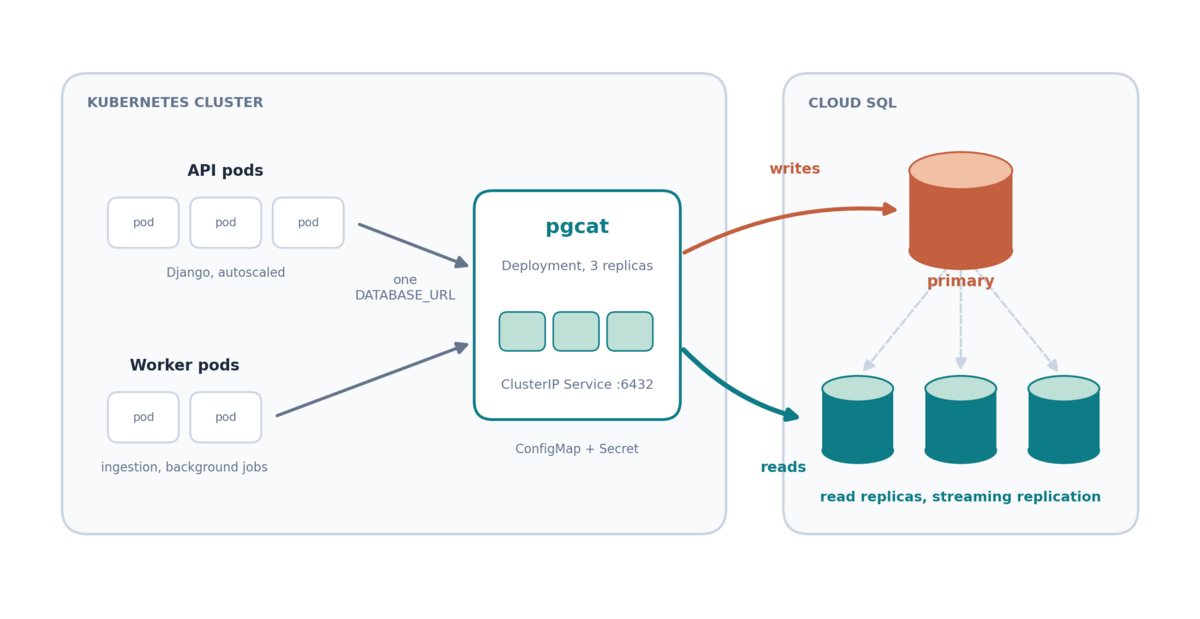 The application keeps one connection string. pgcat routes each statement,
writes to the primary and reads across the replicas, while Cloud SQL keeps the
replicas in sync.
The application keeps one connection string. pgcat routes each statement,
writes to the primary and reads across the replicas, while Cloud SQL keeps the
replicas in sync.
The layout that came out of it:
- Cloud SQL holds the primary and its read replicas, with replication managed by Google.
- pgcat runs inside the Kubernetes cluster, next to the application, and knows about all of the instances.
- The application talks to pgcat and nothing else. Its database URL points at a Kubernetes Service; as far as Django is concerned there is still one database.
pgcat: a pooler that reads the query
The pgcat configuration that matters is small: one pool, one shard (pgcat can also shard, which we did not need), the primary and its replicas listed with their roles, and a handful of switches that turn the pooler into a router.
With the query parser and read/write splitting enabled, pgcat looks at each
statement as it arrives. A plain SELECT goes to one of the replicas, picked
by the load balancer. Anything else, from INSERT and UPDATE to BEGIN and
schema changes, goes to the primary. Reads on the primary are switched off
entirely, which is the whole point: the primary should be doing the 10%, not a
random share of the 90%. And the pool’s default role is set to auto, which
lets the parser decide while leaving the application a way to overrule it,
which we will come to.
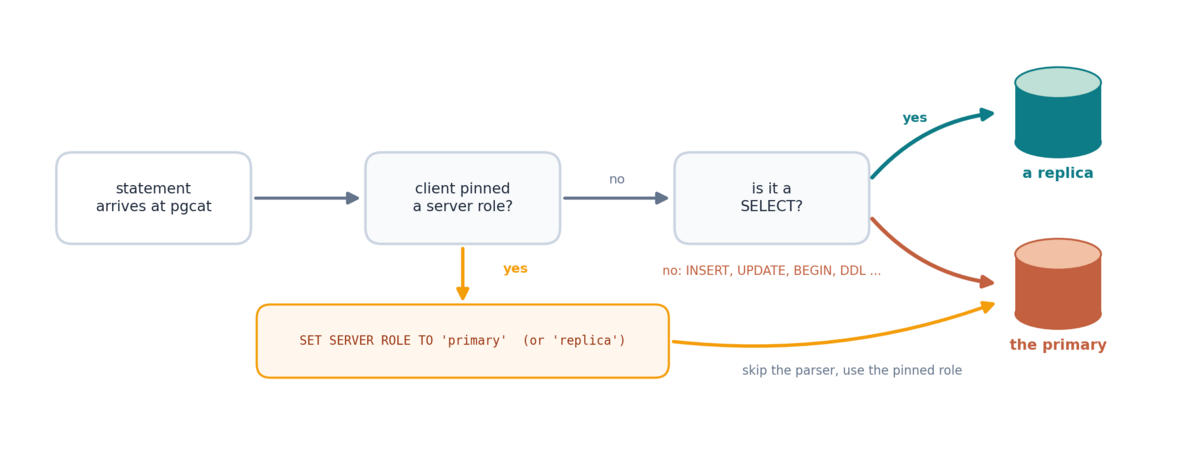 The decision pgcat makes for every statement. The application can pin the
role explicitly and skip the parser.
The decision pgcat makes for every statement. The application can pin the
role explicitly and skip the parser.
One setting deserves a note because it decides how much of the application has to change: the pool mode. In session mode a client keeps the same server connection for as long as it is connected, which is safe but pools poorly. In transaction mode a server connection is borrowed for one transaction and returned, which pools well but breaks anything that assumes state survives between transactions: prepared statements, session-level settings, advisory locks. We audited EarthRanger’s data access for those patterns before deciding, and transaction mode turned out to be safe without application changes. That was luck of a kind, but luck you only get by checking.
Running it in Kubernetes
EarthRanger’s API and workers already run in Kubernetes, so pgcat went in as a regular workload next to them: a Deployment with several pgcat replicas behind a ClusterIP Service, the configuration in a ConfigMap, and the database credentials in a Secret.
The application’s change is then a single line: its DATABASE_URL points at
the pgcat Service inside the cluster instead of the Cloud SQL primary.
We chose a standalone Deployment over a sidecar in every application pod for three reasons. There is one place to change the routing: a new replica is added to the ConfigMap, not to every pod spec. The pooler’s lifecycle is independent of the application’s, so rolling out a new API version does not churn database connections, and rolling out a pgcat config does not restart the API. And the number of real connections to Cloud SQL is bounded by a handful of pgcat pods with known pool sizes, rather than by however many application pods the autoscaler decides to run today.
When the pooler must not decide
The automatic split worked on the first try for the vast majority of the platform. Then someone saved an event and refreshed the page, and the event was not there.
This is the classic read-your-writes problem, and every read replica setup meets it. Replication is fast, usually a few milliseconds, but it is not instant. A request that writes a row to the primary and then immediately reads it back can be routed, by a perfectly correct parser, to a replica that has not received the row yet. The user sees their own change disappear for a moment. Most of the time the next refresh fixes it. That is not good enough for an operations platform.
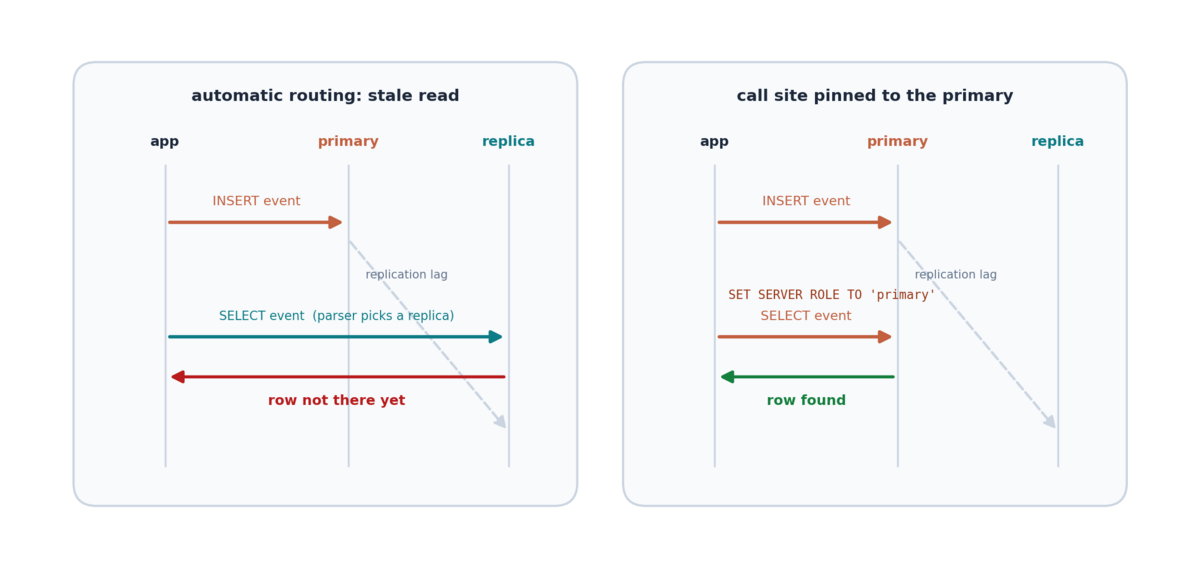 Left: the write goes to the primary, the read goes to a replica that is a few
milliseconds behind, and the row is missing. Right: the application pins the
read to the primary.
Left: the write goes to the primary, the read goes to a replica that is a few
milliseconds behind, and the row is missing. Right: the application pins the
read to the primary.
pgcat offers exactly the escape hatch this needs. A client can send
SET SERVER ROLE TO 'primary';
on its connection, and from then on pgcat routes that client’s statements to
the primary regardless of what the parser thinks, until the client sends
SET SERVER ROLE TO 'auto' or disconnects. This is not a PostgreSQL SET;
pgcat intercepts it and never forwards it to the server. It is the reason
default_role was set to auto rather than hard-coded: auto means “the
parser decides unless the client says otherwise”.
In the Django application this became a small context manager, use_primary,
that pins the connection to the primary on entry and hands control back to the
parser on exit. Developers wrap it around the code paths known to read straight
after writing, and nothing else changes.
The important design choice here is that the override is per call site, and opt-in. We considered the alternatives: pinning every non-GET request to the primary, or making a user “sticky” to the primary for a few seconds after any write. Both are blunter, both silently move read traffic back onto the primary in ways that are hard to see, and both hide the actual dependency. A context manager at the call site documents, in the code, that this read depends on that write. It is more work up front and far easier to reason about later.
The same mechanism solved a second, less obvious case: migrations. Schema
changes are DDL, and DDL must run on the primary; a replica would reject it.
Django’s migrate command mostly issues statements the parser would route
correctly anyway, but “mostly” is not a word you want anywhere near a schema
change on a live database. So the migration entry point pins its connection to
the primary before it does anything else, and the parser never gets a vote.
Rolling it out on a live system
Everything above is the easy part. The hard part is that EarthRanger is never off. Collars keep reporting, rangers keep patrolling, and the platform has to keep working through the change. And the change is unusually broad: it does not touch one endpoint or one table, it changes the path of every query in the system. A wrong route is not a crash you can catch in a test suite. It is a stale read that a user notices on a map, or a write that a replica refuses.
So we planned the rollout as carefully as the architecture.
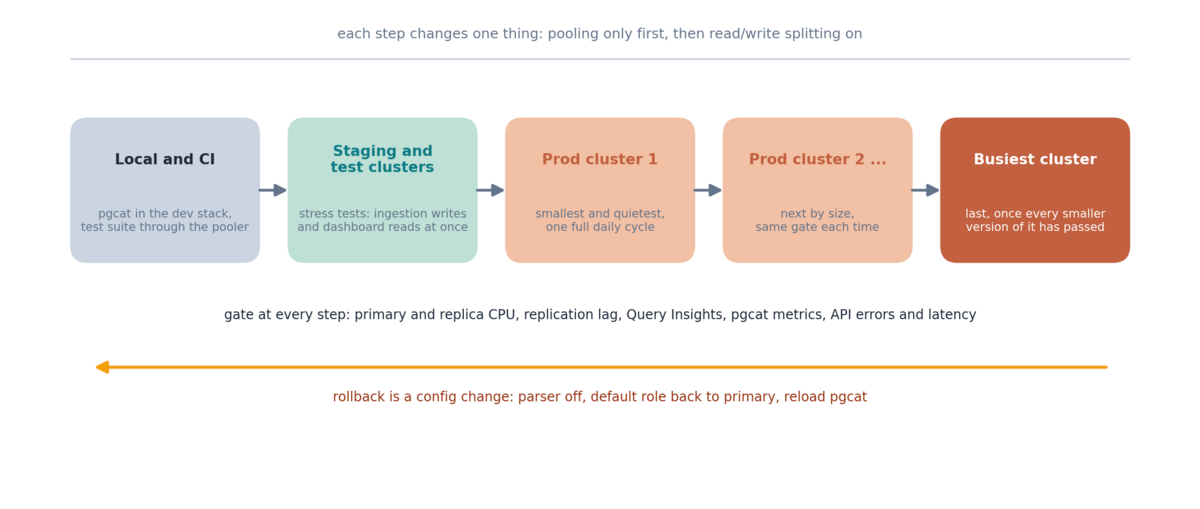 Every step was gated on the metrics from the previous one, and every step
could be reversed with a configuration change.
Every step was gated on the metrics from the previous one, and every step
could be reversed with a configuration change.
Stage the change so each step changes one thing. pgcat first went in with
the query parser off and default_role = "primary", so the only thing that
changed was the connection pooling. Once that was stable, read/write splitting
was switched on. Each step had its own failure modes and we wanted to see them
separately.
Stress test before touching production. EarthRanger has staging and test clusters that mirror production, and we ran realistic load through them with the full pgcat setup: ingestion writes and dashboard reads at the same time, at and above production rates. This is where the read-your-writes cases surfaced, and where the migration path was exercised end to end, before a single production query was rerouted.
Roll production out one cluster at a time. EarthRanger runs several production clusters. We migrated them progressively, smallest and quietest first, the busiest last, so that every step was rehearsed on a smaller version of itself. Each cluster ran on the new path for long enough to see a full daily cycle, including the morning peak when everyone opens the map at once, before the next one moved.
Watch the right signals. At every step we watched a small dashboard of things that would tell us if the routing was wrong before users did:
- Cloud SQL instance metrics: CPU and active connections on the primary (which should fall) and on each replica (which should rise and stay even), and replication lag, which is the number that decides whether read-your-writes will bite.
- Cloud SQL Query Insights: the slowest queries and where they ran, to catch a heavy read that was still landing on the primary or a query pattern that behaved differently on a replica.
- pgcat’s own metrics, exported for Prometheus: connections per pool, wait times, and errors. A replica that fails a health check gets banned by pgcat for a while and traffic silently falls back to the others, which is exactly what you want in an incident and exactly what you want to know about.
- Application error rates and latency on the busiest API endpoints, the measure users actually feel.
Keep the rollback boring. At every stage the way back was a configuration
change: turn the parser off, set the default role back to primary, reload
pgcat. No code deploy, no data migration, nothing that needed a runbook longer
than a paragraph. We never needed it in production, which is the outcome you
plan for by assuming you will.
What it bought us
The primary now does the 10% of the work that only it can do, and the 90% that is reads is spread across replicas. Dashboards and maps stay responsive during ingestion peaks because they are no longer competing with ingestion at all.
The deeper change is in how the platform grows. Before, every new partner meant more reads on the same primary, and eventually another expensive step up in instance size. Now reads scale horizontally: onboarding a wave of new protected areas means adding a replica to Cloud SQL and one line to a ConfigMap. The primary’s size is set by the write load, which grows much more slowly, and its headroom is no longer the thing that decides whether the next park can come on board.
Three things we would do again on any similar system:
- Put the routing in the infrastructure, not the application. A pooler that parses queries let a large, mature codebase move to replicas without a rewrite, and left one place to reason about where queries go.
- Make the override explicit and local. Read-your-writes is inevitable; the fix that documents itself at the call site beats the one that hides in a middleware.
- Treat the rollout as part of the design. Staging one variable at a time, stress testing before production, migrating clusters from smallest to busiest, and keeping the rollback to a config change is what made a change to every query in a live platform an uneventful one.